 Chat with us

Call us now :07313725902
 Send Inquiry
 Send Inquiry
Vacuum Degasser for Steel Treatment
Price 4500000 INR/ Set
MOQ : 1 Set
Vacuum Degasser for Steel Treatment Specification
- Equipment Type
- Vacuum Degasser
- Material
- Stainless Steel, Alloy Steel
- Processing Type
- Steel Refining
- Condition
- New
- Technology
- Vacuum Degassing
- Dimension (L*W*H)
- Customized as per requirement
- Power Mode
- Electric
- Voltage
- 380-415 V, 3 Phase
- Power Consumption
- Depends on Model (typically 30-100 kW)
- Pressure Output
- 0.1 to 1 mbar
- Application
- Steel Treatment, Metallurgical Industry
- Coating Type
- Anti-Corrosive Surface Treatment
- Accessories
- Control Panel, Valves, Pumps
- Vacuum Pump Type
- Roots Pump and Oil Ring Vacuum Pumps
- Usage Environment
- Industrial, High Temperature Zones
- Maintenance
- Low, with Easy Access for Servicing
- Cooling System
- Water Cooled
- Shell Thickness
- 10-30 mm (as per design)
- Noise Level
- Below 85 dB
- Automation Grade
- Automatic/Semi-automatic
- Control System
- PLC Based with Manual Override
- Service Support
- On-site Commissioning and Training
- Gas Removal Efficiency
- Up to 99%
- Operation Temperature
- Up to 1700°C
- Compliance Standards
- Meets International Metallurgical Norms (EN/ISO)
- Installation Type
- Floor Mounted
- Flow Rate
- Variable, controlled via automation
- Capacity Range
- 5 - 100 Ton/Batch
Vacuum Degasser for Steel Treatment Trade Information
- Minimum Order Quantity
- 1 Set
- Supply Ability
- 1 Set Per Month
- Delivery Time
- 15 Days
About Vacuum Degasser for Steel Treatment
VACUUM DEGASSING PROCESSES:Vacuum degassing is practiced in the steel industry as under :
- To remove hydrogen
- To improve cleanliness by removing part of the oxygen
- To produce steel of low carbon content ( < 0.03%)
- To produce steels to close chemical composition ranges (including deoxidizers), and
- To control pouring temperatures, especially for continuous casting operations.
Vacuum degassing processes of molten steel to a low-pressure environment to remove gases (chiefly hydrogen and oxygen) from the steel. The effectiveness of any vacuum degassing operation depends upon the surface area of liquid steel that is exposed to low pressure. The mechanisms of hydrogen and oxygen removal from liquid steel are related directly to surface area.
Hydrogen removal is a diffusion and partial pressure phenomenon. Oxygen removal is a function of chemical reaction of oxygen with carbon and the partial pressure of carbon monoxide.
The processes of degassing treatment : composition and temperature control; decarburization; micro cleanliness; and inclusion morphology. Under the vacuum degassing treatments three processes which primarily use this treatment are stream degassing, recalculation degassing and vacuum degassing in the ladle can posible.
- Vacuum Degassing
- 5 to 50 MT Capacity
- Vacuum less than 1 millibar
- Transformer Capacity 2 to 7.5 MVA
- Tank Degassing with 6 Ejectors and 3 Boilers
- Automatic Ferro Alloy Addition System
- Continuous Argon purging
- Vacuum Oxygen Decarburisation facility at optional
- Wire Feeding Capability
- Automatic Temperature and sampling system
Advanced Technology for Superior Steel Quality
Our vacuum degassing system leverages cutting-edge vacuum pump combinations to extract unwanted gases from molten steel. This process, compliant with international metallurgical norms, dramatically improves final product characteristics such as strength, ductility, and cleanliness, crucial for high-performance applications.
Flexible Automation and Control
The degasser features a PLC-based control system with manual override, allowing you to tailor operation to specific requirements. Its semi-automatic to fully automatic options, variable flow rates, and simple human interface ensure seamless integration into both modern and traditional steelmaking lines.
Efficient, Safe, and Low Maintenance Operation
Designed for industrial environments, it offers quiet performance (below 85 dB), robust anti-corrosive build, and low maintenance needs. Water cooling and easy servicing accessibility reduce downtime. Our support includes on-site commissioning and operator training for a smooth transition and reliable operation.
FAQs of Vacuum Degasser for Steel Treatment:
Q: How does the vacuum degasser improve steel quality during treatment?
A: The vacuum degasser removes dissolved gases such as hydrogen and nitrogen from molten steel using high-efficiency Roots and Oil Ring vacuum pumps. This gas removal process (up to 99% efficiency) minimizes porosity and inclusions, resulting in cleaner, stronger, and more ductile steel.Q: What types of steel production processes is this vacuum degasser suitable for?
A: This vacuum degasser is designed for a wide range of steel refining applications, accommodating batch capacities from 5 to 100 tons. It is suitable for use in steel treatment plants, foundries, and metallurgical industries operating at high temperatures up to 1700C.Q: When is vacuum degassing typically implemented in the steelmaking process?
A: Vacuum degassing is usually applied after primary melting and initial refining but before final alloying and casting. This timing ensures maximum removal of unwanted gases, thereby enhancing the quality and homogeneity of the finished steel products.Q: Where can the vacuum degasser be installed within a steel plant?
A: Designed for floor mounting, the degasser is adaptable to various plant layouts. Its compact and customizable dimensions mean it can be efficiently integrated into both new and existing steel production lines, even within challenging high-temperature industrial environments.Q: What are the main benefits of automation and PLC-based control for this system?
A: PLC-based automation provides precise process control, repeatability, and safety. Manual override is available for flexibility. Automated variable flow rates and system monitoring help optimize operational efficiency while reducing human error and maintenance demands.Q: How is the vacuum system maintained, and what support is provided?
A: The system is engineered for low maintenance with easy access points for servicing. The manufacturer offers on-site commissioning and operator training, ensuring your team can perform routine checks and promptly address any issues, maximizing system uptime and performance.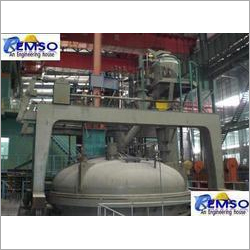
Tell us about your requirement

Price:
Quantity
Select Unit
- 50
- 100
- 200
- 250
- 500
- 1000+
Additional detail
Mobile number
Email

More Products in Vacuum Degasser Category
Vacuum Degasser
Price 15000000 INR / Set
Minimum Order Quantity : 1 Set
Condition : New
Power Mode : Electric
Voltage : 380V / 50Hz
Technology : Other, Vacuum Suction

 Send Inquiry
Our Products
- Hydraulic Pusher Manipulator for Furnace
- Ladle Transfer Car
- Hot Metal Transferring Equipment
- Billet / Bloom Grinding Machine
- Steel Melt Shop Equipment
- Ladle Refining Furnace
- Continuous Casting Machine
- Vacuum Degasser
- Oxygen Decarburization Vessel
- Argon Oxygen Decarburization Converter
- Vacuum Oxygen Refining Furnace
- Scrap Management
- Tundish Drying and Preheating System
- Wire Feeding Machine
- Automatic Temperature Sampling Manipulator
- Ladle Drying Station
- Electric Arc Furnace
- Tundish Drying Station
- Tundish Tilter Turnover Device
- Slab Turnover Tilting Device
- Cored Wire
- Foundry Ladle
- Rotary Kiln
- Gas Based DRI Plant
- Scrap Baling Machine
- Immersion Sensor
- Continuous casting Machine Equipments
- Slag Raking Machine
- Ladle Drying And Preheating Station
- Materials Handling Equipment
- Scrap Management And Optimisation Solutions
- Hot Metal Ladle for Steel Plant


B No. D-157, Road No. 24, Site -5, Greater Noida Export Promotion Industrial Park,Greater Noida - 201310, Uttar Pradesh, India

Mr Madan Kumar
(Director)
Mobile :07313725902
 Send Inquiry
 Send SMS
 Call Me Free
Developed and Managed by Infocom Network Private Limited.
